

Last night I told my son to go to his room because he had been rude. His answer: "You know if you keep acting like this, you're going to be punished."
Oops.
Something is wrong. And I am not alone. I know strong parents exist out there, but there are many of us who have given too much power to our kids. We are encouraging our children to be free and outspoken, to be empowered. But we are not helping them build their character. We are not teaching them enough about limits and discipline, about empathy and respect.
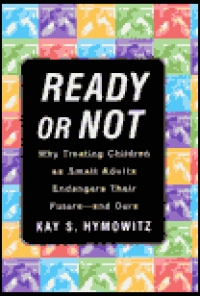
Ready or Not by Kay Hymowitz attacks the prevailing attitudes toward children. The author argues that the current popular philosophies of raising and educating children are disastrous for our society. We allow the child too much freedom and put the child in control, a place where he is ill-equipped to sit. It's a little like putting a kid in the driver's seat of a car. He'll have a great time. But he's bound to steer the car off the road and hurt both of you.
All of us are being damaged by letting kids run the show.
Though Hymowitz's argument is correct about the culture as a whole, her argument is supported by evidence that ignores the reality of flesh and blood kids and parents. There are arents who demand disciplined, respectful kids and kids who prefer playing tennis or cards to watching MTV. In fact, one could argue that a strong family is its own culture, shielding and protecting a child from the greater culture.
Nevertheless, as a general cultural indictment, her book contains a powerful message: All of us are being damaged by letting kids run the show.
What Happens when we Put the Kids in Charge?
Hymowitz first presents a cultural history of childrearing before examining how "the kid in charge" ethos is expressed in modern parenting theories, education, the media, and our basic understanding of what the pre-teen and teen years are all about.
She tells us that prior to the 19th century, children were treated as members of the family who shared in the work. There were no special toys for them, and they were sometimes treated harshly. Parents were definitely in control.
But at the turn of the 19th century, inspired by Locke and Rousseau and the egalitarian spirit of the times, a new kind of childrearing philosophy emerged. Hymowitz refers to this philosophy as a republican attitude toward children. Children were educated as members of a free republic. Children were raised with freedom - but that freedom was for a purpose: to be a citizen who would make decisions and participate in a democracy. Freedom was in the service of democracy.
Hymowitz tells us that the basic assumption of freedom for the purpose of democracy has been left by the wayside; today we know only the idealization of freedom, without consequence and without purpose. As a result, we have given our children a dangerous combination of too much autonomy, too much decision-making power, and too much independence.
It's a little like putting a kid in the driver's seat of a car. He'll have a great time. But he's bound to steer the car off the road and hurt both of you.
Today, republican childraising has been degraded to a philosphy of anti-culturalism. Anti-culturism tells us that parents should not transmit our culture and values to our children. Indeed there is no coherent culture to transmit. Instead we should step aside. Children are inherently good, inherently rational, and inherently able as long as parents and educators can let kids' natural talent, genius, and creativity emerge. We have no real culture to pass on to our children. On the contrary, by passing on culture, we risk impeding their natural growth and creativity - their freedom. "Left to themselves, children will be carried along by what anti-cultural educators call "intrinsic motiviation," argues Hymowitz. For example, Teresa Amabile, an expert in education, believes that elementary school chldren should be responsible for monitoring their own work: outside evaluation by a teacher can kill their creativity.
The Cult of the Young
This emphasis on putting children at the helm of their educational process results in a dumbing down of education. Kids don't need to be taught: kids can figure out things for themselves. Out of this comes the belief that teachers should be facilitators, not educators.
The media has capitalized on this freedom and independence of the young by treating the young as a consumer group -- cool, pouting, ironically detached. Tweens, eight-12 years old, are targetted as consumers who are already tasting the freedom associated with teenagers.
In fact in our society, it's the young who are idealized, and the adults who want to be like them. The kids are the ones who know computers and MTV and what's cool; the slang, the lingo, the music, the movies-- everything exists for their pleasure.
Hymowitz's argument is powerful, although she overstates her case. There are plenty of parents who limit their kids and contain their kid's ego and irrationality. Not every educational theorist or teacher subscribes to the myth of children's natural genius and rationality.
Furthermore, as culture becomes less unified, so does anti-culturalism. As sub-cultures become stronger, certainly some of them will stress respect for parents and less freedom and power for kids. In a sense, the segmentation of the culture works against Hymowitz's thesis.
Still, Ready or Not is provocative reading. Hymowitz makes a powerful case - in fact, perhaps too powerful. At times her argument seems almost too airtight. She anticipates no objections to her argument and thus brings no real refutation of an opposing point of view. But a return to less democratic child rearing methods could be disastrous and return us to an era when kids were seen and not heard, when their natural talents were sometimes tragically unrealized.