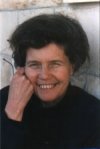

I had never thought much about aging. Even now, at 63, I continue to proclaim, "I don't take my age personally," in spite of the fact that the human forest in which I live is thinning out. Many friends and members of my family, cousins with whom I grew up, even a younger sister, have died, crossed from the land of the living to Hamlet's "undiscover'd country from whose bourn/No traveler returns." I have somehow not attributed it to age. Sickness, yes. But aging?
I am as active as ever. So are my friends who are living productive lives, many of them women whose careers took off when they were in their forties and their children had grown up. Today, as people live longer, there are the young-old in their sixties and seventies, and the older-old, seniors in their eighties and nineties. There are even those who begin entirely new careers at 65, an increasingly common phenomenon.
And yet, slowly, I have had to admit that the losses become greater as we get older. We are all more vulnerable. There is increased incidence of illness and death as we move from the fifties to the sixties to the seventies and eighties and beyond. Many of my age group are now widows and widowers. As one friend said, "We used to complain about our husbands' foibles. Now we only hope that they stick around." These are objective factors that cannot be denied.
Paradoxically, it is a new job, new challenges as Director of the Senior Center of WholeFamily, that has brought me face to face with the issues of aging. And I don't plan to look the other way, play the ageless Peter Pan, create a Senior Center that is Pollyanish, pretend that loss doesn't exist. And yet, there is also profound gain: The anchoring of a life, watching new generations develop.
Important Senior Issues Highlighted in our Senior Center
In this launch, our first appearance on WholeFamily.com, there is Leah Abramowitz's article on Dealing With Death and Dying and Dorothy's Diary, where Dorothy struggles with the issues of renewal after her spouse passed away. Bob faces the question, To Retire Or Not? and the identity crisis this entails. "Who am I?" he wonders if he's no longer a lawyer applying his well-honed skills to his work. How does one retain a sense of self when one is no longer defined by the job which has bestowed an identity for so long? And when Bob does finally retire in the drama Shifting Gears, how does Carol deal with a husband who is at home all the time? After all, as the saying goes, "I married you for better or for worse, but not for lunch every day."
Loss must be addressed and memories sustained. We struggle to hold onto the gesture or smile of a loved one who has passed on, to perpetuate some insight or approach to life. These traces embedded in the strata of memory must be kept alive. In Silver Snapshots we present profiles of grandparents or special elders whom we remember. But it is not only seniors who are remembering. Young people remember grandparents. We hope that young and old will visit our site, and share their reminiscences, that our site will be truly intergenerational.
The young and not so young are often overwhelmed with an ailing parent or spouse, struggling with the responsibilities of caregiving, as presented in the dramas, Babying Mom and I Feel Like a Sandwich.
Many common dilemmas echo through every period of life; identity crises, marital disappointments, parent-child conflicts. These conflicts don't stop when a child becomes a parent and a parent becomes a grandparent. There are similarities, for example, between teenagers' involvement with their body image, as their body changes and takes shape, and older peoples' need to accommodate to a changing, aging body. What role should it play in our lives? How can we maintain healthy bodies, experience the joy of "feeling in the body" and yet not allow this to be our primary goal in life? In Letters on Body Image, Felice raises this issue.
Embracing the World Around Us
Like many other senior Websites, WholeFamily will direct seniors to vacations, retirement homes, the enjoyment of life. Celia Berger's Retirement Tips introduces us to the broadening possibilities of retirement.
But we hope to do more than that. We want to share psychological insight, human wisdom, to help us learn how to relate to friends, family and ourselves. We would like to encourage reflection upon the human condition through stories and reminiscences, the study of great literature, to enhance the medieval quality of "caritas," illumination. Most of all, we hope that together we can, in this third part of our lives, come to embrace the world around us, every blade of grass and human quirk with love and joy. Indeed, may we see each day as the one declared in Psalms, "This is the day that God has created. Let us be happy and rejoice in it."